

Property investment can seem complicated when you are just getting started. There are buy-to-let mortgages to understand, rental yields to calculate, locations to research, taxes and purchasing costs to consider, and several different investment strategies to choose from.
Then there is the biggest question of all: how do you know whether a property is actually a good investment?
The good news is that you do not need to know everything about property before buying your first investment. What you do need is a clear understanding of the fundamentals, a sensible strategy and the discipline to check the numbers before committing your money.
Property investment is ultimately a business decision. A property that looks attractive, is located in a popular area or appears cheap compared with neighbouring homes is not automatically a good investment. The purchase needs to work financially and fit the strategy you intend to follow.
For some investors, that means buying a property and renting it out for long-term income. Others may buy a property that needs improvement, renovate it and refinance it. Some investors prefer to renovate and sell properties for a profit, while more experienced investors may consider HMOs, conversions or development projects.
Each strategy has different capital requirements, risks and potential returns.
That is why one of the most important things a beginner can do is understand what they are trying to achieve before they start looking at properties.
Are you looking for monthly rental income? Long-term capital growth? A way to build a property portfolio? A short-term profit from refurbishment? Or perhaps a combination of income and growth?
Your answer will influence the type of property you buy, where you buy it, how you finance it and how you assess whether the investment makes sense.
What You Will Learn in Property Investment for Beginners UK Guide
This guide explains the property investment process from a UK beginner’s perspective.
We will look at:
- how property investment works;
- how much money you may need to get started;
- the main UK property investment strategies;
- how to choose an investment location;
- how to find potential investment properties;
- how to calculate rental yield and cash flow;
- the different ways property purchases can be financed;
- the costs that new investors sometimes overlook;
- common property investment mistakes; and
- how to put together a practical plan for buying your first investment property.
We will also work through a simple property investment example so you can see how the purchase price, deposit, mortgage, rent and expenses interact.
The objective is not simply to buy a property.
It is to understand why you are buying it, how you expect the investment to make money and what could happen if things do not go according to plan.
A well-researched property can still experience unexpected repairs, interest-rate changes, void periods or slower-than-expected capital growth. Successful investing therefore involves looking beyond the potential return and considering the risks as well.
If you are considering your first UK investment property, the best place to begin is with the fundamentals.
So, what exactly is property investment, and how does an investor make money from it?
What Is Property Investment?
Property investment is the process of buying property with the intention of generating a financial return rather than simply using it as your own home.
That return can come from rental income, an increase in the property’s value, adding value through improvements, or a combination of these.
For example, an investor might buy a house for £180,000 and rent it to tenants for £1,100 per month. After paying the mortgage and other expenses, the remaining income may provide a monthly profit.
Alternatively, an investor could buy a property requiring refurbishment for £140,000, spend £30,000 improving it and potentially increase its value to £220,000. Depending on the strategy, the investor could then sell the property, refinance it or retain it as a rental.
Although both examples involve investing in property, they are very different strategies. This is why understanding how you expect a property to make money is important before you buy.
How Does Property Investment Make Money?
There are several ways to generate a return from property, but most residential property investments rely on three main methods.
1. Rental Income
Rental income is the money paid by tenants to occupy your property.
If a property generates £1,200 per month in rent, the annual gross rental income would be:
£1,200 × 12 = £14,400
However, the entire £14,400 is not profit.
A landlord may have expenses including:
- mortgage interest;
- letting or management fees;
- insurance;
- maintenance and repairs;
- safety and compliance costs;
- service charges and ground rent where applicable; and
- periods when the property is vacant.
What remains after the relevant expenses have been deducted gives a much better indication of the property’s actual cash flow.
This distinction is important for beginners because a property offering an attractive headline rent does not necessarily produce strong monthly profit.
2. Capital Growth
Capital growth occurs when a property’s market value increases over time.
For example, if you buy a property for £200,000 and several years later it is worth £250,000, the property has increased in value by £50,000.
Historically, long-term property price growth has been one reason people invest in UK residential property. However, property prices do not increase at the same rate everywhere, and growth is never guaranteed.
Prices can stagnate or fall, particularly over shorter periods.
For that reason, relying entirely on the assumption that “property prices always go up” can be a dangerous investment strategy.
A stronger investment should ideally make financial sense based on today’s realistic numbers, rather than depending entirely on future house-price growth.
3. Adding Value to a Property
Investors can also generate returns by deliberately increasing the value of a property.
This could involve relatively straightforward improvements such as:
- installing a new kitchen or bathroom;
- improving the property’s condition;
- repairing structural or maintenance problems;
- modernising outdated accommodation; or
- improving the layout.
More substantial projects might involve extensions, conversions or changes of use, subject to the necessary planning permission and regulations.
Suppose an investor purchases a dated property for £150,000 and spends £25,000 renovating it.
If comparable renovated properties in the area are selling for around £220,000, there may be an opportunity to create additional value.
But the calculation cannot simply be:
£220,000 − £150,000 − £25,000 = £45,000 profit
The investor must also account for acquisition costs, finance, legal fees, taxes, selling costs and unexpected expenditure.
This is one of the reasons experienced investors focus on the whole deal, rather than simply the difference between the purchase price and expected future value.
Property Investment vs Buying Your Own Home
Buying an investment property is fundamentally different from buying somewhere to live.
When purchasing your own home, personal considerations naturally matter. You might pay more because you love the kitchen, want to live near family, prefer a particular street or can imagine yourself staying there for many years.
An investment property should be assessed differently.
The important questions become:
What rent could it realistically achieve?
What are the running costs?
How strong is tenant demand?
What return could I make on the money invested?
What happens if interest rates or costs increase?
How easily could I sell or refinance the property?
An investment property therefore needs to be approached primarily as a financial asset and business decision.
That does not mean the property’s condition, appearance or location are unimportant. They can directly influence tenant demand, rent and future resale value.
The difference is that those factors should ultimately support the investment case rather than simply your personal preferences.
Property Investment Is Not Automatically Passive Income
Property is sometimes presented as an easy way to generate passive income.
The reality can be quite different.
Even when a letting agent manages the day-to-day tenancy, the property owner remains responsible for important financial and strategic decisions. Repairs may arise unexpectedly, tenants can leave, mortgage costs can change and regulations affecting landlords can evolve.
Some strategies require considerably more involvement than others.
A straightforward buy-to-let property managed by an agent may require relatively little day-to-day attention. A refurbishment, BRRR project or property development can involve contractors, finance, valuations, budgets, schedules and unexpected problems.
Beginners should therefore consider not only how much money they have available, but also how much time and involvement they are prepared to commit.
Think of Property as a Business
One of the most useful mindset changes for a new investor is to stop thinking simply about buying a property and start thinking about making an investment.
Before committing to a purchase, you should be able to explain:
- what your investment strategy is;
- how the property is expected to generate a return;
- how much capital you need;
- what your expected income and expenses are;
- what the major risks are; and
- how you intend to exit the investment.
Your exit could mean selling the property, refinancing it, holding it for long-term rental income or eventually using the equity to help fund another investment.
Having this clarity before purchasing can help prevent one of the most common beginner mistakes: buying first and deciding what to do with the property afterwards.
Now that we understand how property investment works, the next question is one almost every new investor asks:
Is property still a good investment in the UK?
Is Property Still a Good Investment in the UK?
Property can still be a good investment in the UK, but that does not mean every property is a good investment.
This distinction is particularly important for beginners.
A property might be located in an area where house prices have historically performed well, but if you pay too much for it, achieve a lower rent than expected or underestimate the running costs, the investment may still produce a poor return.
Likewise, a relatively inexpensive property can turn out to be a strong investment if there is good rental demand, sensible financing and sufficient income after expenses.
Rather than asking whether UK property as a whole is a good investment, a more useful question is:
Does this particular property, at this particular price, work for my investment strategy?
There are several reasons investors continue to consider UK residential property.
Potential for Rental Income
One of the main attractions of buy-to-let property is the ability to generate regular rental income.
If you own a property that tenants want to live in and the rent comfortably covers the property’s ongoing expenses, it may provide positive monthly cash flow.
For example, suppose a property generates £1,200 per month in rent.
That gives annual gross rental income of:
£1,200 × 12 = £14,400
However, the £14,400 should never be treated as your annual profit. Mortgage interest, insurance, maintenance, management fees, compliance costs and void periods can significantly reduce the amount you actually retain.
For this reason, beginners should look beyond the advertised rent and calculate the likely net cash flow.
Anyone planning to let a property should familiarise themselves with their legal responsibilities as a landlord, including requirements relating to property safety, deposits and energy performance.
Potential for Long-Term Capital Growth
Property can also increase in value over the long term.
If you purchase a property for £180,000 and eventually sell it for £240,000, you have benefited from £60,000 of capital growth before accounting for purchasing, ownership and selling costs, improvements and any applicable tax.
But capital growth should never be assumed.
Different parts of the UK can perform very differently, and property markets move through periods of growth, stagnation and decline.
A sensible beginner should therefore avoid buying a property purely because they expect its value to rise.
Ideally, the investment should have a sound financial case without depending on optimistic future house-price growth.
The Ability to Use Leverage
Property is unusual because investors can often use borrowed money to purchase a relatively valuable asset.
Suppose you buy a £200,000 investment property using a £50,000 deposit and a £150,000 mortgage.
You have invested £50,000 towards the purchase price but control an asset worth £200,000.
This is known as leverage.
Leverage can increase returns when an investment performs well, but it can also increase risk. Mortgage payments still need to be made when the property is vacant, repairs are required or rental income falls below expectations.
Interest-rate changes can also have a significant impact on profitability.
Borrowing should therefore be treated as an investment tool rather than simply a way to buy more expensive property.
Property Can Provide More Than One Type of Return
Another attraction of property is that an investment may generate returns in several ways.
A successful property could potentially provide:
Rental income while you own it.
Capital growth if its market value increases.
Added value if improvements increase its value.
And over a long period, mortgage repayments may also change the amount of equity you hold in the property, depending on the type of mortgage being used.
This combination is one reason property remains attractive to many long-term investors.
However, none of these returns is guaranteed.
Property Also Comes With Risks
It is easy to focus on potential profits when starting out, but property investment carries genuine financial risks.
These can include:
- falling property prices;
- higher mortgage rates;
- unexpected repairs;
- refurbishment costs exceeding the budget;
- tenants failing to pay rent;
- periods without tenants;
- changes to taxation;
- changes to landlord regulations;
- difficulty refinancing; and
- being unable to sell quickly when you need your money.
Property is also relatively illiquid.
If you own shares, you may be able to sell them relatively quickly. Selling a property can take weeks or months and involves legal work, estate agency costs and potentially significant transaction expenses.
This makes having sufficient cash reserves particularly important.
Regulation and Tax Matter
UK landlords operate within an increasingly regulated environment.
Depending on the property and location, landlords may need to consider matters such as electrical and gas safety, energy-efficiency requirements, deposit protection, property licensing and other legal obligations.
Tax also affects the actual return from an investment.
Stamp Duty Land Tax and the higher rates applicable to additional residential properties can materially increase acquisition costs in England and Northern Ireland, while Scotland and Wales operate different property transaction tax systems.
Income tax or corporation tax may apply to profits depending on how the property is owned, and Capital Gains Tax can potentially arise when an investment property is sold personally.
Tax rules can change, so investors should check the current position and obtain professional advice where necessary.
Inflation and Property
Property is sometimes described as a hedge against inflation because property values and rents may increase over long periods.
But this relationship is not guaranteed.
Inflation can also increase an investor’s expenses. Building materials, contractor charges, insurance, maintenance and finance costs can all rise.
The important question is therefore not simply whether rents increase, but whether income increases faster than the costs of owning the property.
So, Is UK Property Worth Investing In?
For the right investor and the right deal, it can be.
But successful property investment should not depend on the belief that simply owning property will automatically make you money.
A stronger approach is to buy based on:
- realistic rental figures;
- sustainable financing;
- sensible purchase prices;
- adequate cash reserves;
- clear investment objectives;
- proper research; and
- a workable exit strategy.
Most importantly, the numbers should make sense before you buy.
A good investment is not necessarily the cheapest property, the property with the highest advertised yield or the one expected to increase most rapidly in value. It is a property whose potential return justifies the capital, time and risk involved.
If you plan to become a landlord, it is worth understanding these obligations before purchasing; this landlord compliance checklist provides a more detailed overview of the key requirements UK landlords need to consider.
And before you can decide what type of property you should buy, there is another fundamental question to answer:
How much money do you need to start investing in UK property?
How Much Money Do You Need to Start Investing in Property?
There is no single amount of money you need to start investing in UK property.
The amount depends on several factors, including the price of the property, your investment strategy, how you intend to finance the purchase and the amount of work the property requires.
This is why asking, “Can I start property investing with £20,000?” or “Is £50,000 enough?” does not have a simple yes-or-no answer.
A £30,000–£40,000 pot might be enough for one type of investment in a lower-priced area but nowhere near enough for another property in a more expensive location.
More importantly, beginners should avoid thinking only about the deposit.
Your true investment requirement is closer to:
Deposit + Purchase Costs + Refurbishment + Finance Costs + Contingency
Let’s look at the main costs.
1. Your Property Deposit
If you are purchasing with a buy-to-let mortgage, you will usually need to contribute a significant percentage of the purchase price yourself.
The exact deposit required will depend on the lender, your circumstances and the property. Rather than assuming that a particular loan-to-value will always be available, check what lenders are prepared to offer for the property and strategy you are considering.
For illustration, if you purchased a £160,000 property using a 75% loan-to-value mortgage:
Property price: £160,000
Mortgage: £120,000
Deposit: £40,000
At that point, however, your investment is already going to cost considerably more than £40,000 because there are other acquisition costs to consider.
2. Stamp Duty Land Tax
If you are buying residential property in England or Northern Ireland, Stamp Duty Land Tax (SDLT) may be one of your largest upfront costs.
The amount payable depends on factors including the purchase price and your circumstances. Additional residential properties can also attract higher rates.
Scotland and Wales operate separate property transaction tax systems.
Because tax rates and rules can change, always calculate the tax based on the rules applying at the time of your purchase rather than relying on an old example or calculation you found online.
Stamp duty should be included in your investment budget from the beginning. Forgetting it can significantly underestimate the cash required to complete a purchase.
If you are buying residential property in England or Northern Ireland, you can check the current Stamp Duty Land Tax rates and use HMRC’s guidance to understand what may apply to your purchase.
3. Solicitor and Conveyancing Costs
You will normally need a solicitor or licensed conveyancer to handle the legal side of the purchase.
Costs vary depending on the property and complexity of the transaction.
An auction purchase, leasehold property or unusual title issue, for example, may require more legal work than a straightforward freehold purchase.
Your budget should therefore include both the solicitor’s professional fees and relevant searches, Land Registry charges and other disbursements.
4. Mortgage and Valuation Fees
Financing a property can introduce several additional costs.
Depending on the lender and mortgage product, these could include:
- arrangement or product fees;
- valuation fees;
- broker fees;
- lender legal fees; and
- other administration charges.
Some mortgage fees can potentially be added to the loan rather than paid upfront, but doing so increases the amount borrowed and potentially the interest you pay.
Always compare the overall cost of the finance, not simply the headline interest rate.
5. Survey Costs
A valuation carried out for a mortgage lender is primarily for the lender’s benefit. It should not automatically be treated as a detailed assessment of the property’s condition.
Depending on the property, you may decide to commission an appropriate survey or specialist inspection.
Spending money investigating a potential problem before buying can sometimes prevent a much larger expense afterwards.
This is particularly important when considering older properties or buildings showing signs of structural movement, damp, roofing problems or other defects.
6. Refurbishment and Repairs
If the property requires work, refurbishment can become one of the largest parts of your investment budget.
Even apparently straightforward projects can involve more than decorating and installing a new kitchen.
Potential costs might include:
- electrical work;
- plumbing;
- heating;
- roofing;
- windows and doors;
- plastering;
- flooring;
- kitchens and bathrooms;
- decoration; and
- external repairs.
Before purchasing a refurbishment project, try to establish a realistic scope of work and obtain estimates wherever practical.
Most importantly, include a contingency.
A £25,000 refurbishment budget with no room for unexpected problems can quickly become a problem if the actual cost reaches £32,000.
7. Insurance and Initial Compliance Costs
Before letting a property, you may also need to budget for insurance and any work necessary to ensure the property meets applicable legal and safety requirements.
Depending on the circumstances, this could involve inspections, certificates, alarms, licensing requirements or improvements before tenants can occupy the property.
These costs may appear relatively small compared with the purchase price, but together they can materially affect the amount of cash required.
8. Keep an Emergency Fund
One of the biggest mistakes a beginner can make is putting every available pound into completing the purchase.
Imagine completing your first investment property with only £500 left in your account.
A month later, the boiler fails.
Or the property remains vacant longer than expected.
Or a repair identified after completion costs several thousand pounds.
You may own the property, but you have created a cash-flow problem.
Keeping an appropriate emergency reserve provides protection against unexpected expenses and periods of reduced income.
A Simple Example
Suppose you are considering a property costing £150,000 and plan to use a 75% loan-to-value mortgage.
Your deposit would be:
£150,000 × 25% = £37,500
You might then have additional costs such as:
| Cost | Illustrative Amount |
|---|---|
| Deposit | £37,500 |
| Property tax | £8,000 |
| Legal and searches | £2,000 |
| Mortgage/valuation costs | £1,500 |
| Survey | £600 |
| Initial repairs/improvements | £5,000 |
| Contingency/reserve | £5,000 |
| Total cash required | £59,600 |
These figures are illustrative rather than a quotation or tax calculation, but they demonstrate an important point.
A property requiring a £37,500 deposit could easily require £50,000 or considerably more in available capital once the complete investment is considered.
Can You Start Property Investing With £20,000?
Potentially, but your options may be limited.
You might need to consider lower-priced locations, a different investment strategy, additional funding or building more capital before purchasing.
What you should avoid doing is forcing a deal simply because you want to start immediately.
If your available capital is £20,000 and the investment realistically requires £35,000, the solution is not to ignore £15,000 of costs.
It is better to recognise the funding gap before purchasing than discover it halfway through a transaction or refurbishment.
Don’t Ask Only: “Can I Afford to Buy It?”
A better question is:
“Can I afford to buy it, complete the strategy and still have enough money to deal with something going wrong?”
That is a much stronger foundation for property investment.
Once you understand how much capital you have available, the next step is deciding what type of property investment strategy is most appropriate for you.
The Main Property Investment Strategies for Beginners
There is more than one way to invest in property.
Some investors want relatively straightforward rental properties that they can hold for many years. Others deliberately look for properties requiring refurbishment so they can add value. Some prefer to buy, improve and sell, while others focus on higher-income strategies such as HMOs.
Understanding these differences is important because your strategy determines what type of property you should be looking for.
A property that makes sense as a buy-to-let may not work as a flip. Likewise, a property with excellent potential for refurbishment and resale might generate poor rental cash flow if you decide to keep it.
For beginners, the main UK property investment strategies include the following.
Buy-to-Let
Buy-to-let (BTL) is one of the most established property investment strategies in the UK.
The basic model is straightforward: you purchase a residential property and rent it to tenants, usually under a long-term residential tenancy.
Your return may come from two sources:
- monthly rental income; and
- potential capital growth over time.
Suppose you purchase a property for £180,000 and rent it for £1,200 per month.
The annual rent would be:
£1,200 × 12 = £14,400
The gross rental yield would therefore be:
£14,400 ÷ £180,000 × 100 = 8%
However, the 8% yield does not represent your profit. You still need to account for mortgage costs, maintenance, insurance, management, compliance, voids and other expenses.
Buy-to-let can be a sensible starting strategy because it is relatively easy to understand. But beginners should focus on net cash flow and the overall return, rather than simply chasing the highest advertised rental yield.
Buy, Refurbish, Refinance and Rent (BRRR)
BRRR stands for:
Buy → Refurbish → Refinance → Rent
The objective is to purchase a property where improvements can increase its value.
After completing the refurbishment, the investor refinances the property based on its new valuation and uses the refinancing proceeds to recover some of the capital originally invested.
For example, an investor might:
- buy a property for £120,000;
- spend £30,000 refurbishing it;
- create a property worth £200,000; and
- refinance it once the work has been completed and the lender’s requirements have been satisfied.
If the refinancing works as expected, some of the investor’s original capital may be released and potentially used towards another investment.
This is why BRRR is often associated with building a portfolio.
However, there is a major risk beginners need to understand:
The property may not be valued at the amount you expect.
If you expect a £200,000 valuation but the lender’s valuer assesses the property at £175,000, considerably more of your money could remain tied up in the deal.
Refurbishment costs can also exceed budget, and refinancing criteria vary between lenders.
BRRR therefore requires careful analysis of the purchase price, refurbishment budget, realistic end value, rental income and refinancing assumptions before buying.
Property Flipping
Property flipping involves buying a property, improving it and selling it for a profit.
The strategy can appear simple:
Buy low → Renovate → Sell higher
In practice, there are many costs between the purchase and the sale.
Suppose you buy a property for £140,000, spend £30,000 refurbishing it and sell it for £220,000.
At first glance:
£220,000 − £140,000 − £30,000 = £50,000
It would be a mistake to assume you have made £50,000 profit.
You may also need to account for:
- property transaction tax;
- legal fees;
- finance and interest;
- surveys and valuations;
- insurance;
- utilities and council tax during the project;
- estate agency fees;
- selling legal costs; and
- unexpected refurbishment expenses.
If those additional costs total £20,000, the apparent £50,000 margin has already fallen to £30,000 before considering any applicable tax.
Flipping can generate attractive returns, but the margin needs to be large enough to absorb unexpected costs, delays or a lower-than-expected selling price.
Houses in Multiple Occupation (HMOs)
An HMO is a property occupied by multiple people who are not all part of the same household and who share certain facilities.
Rather than letting the entire property to one household, an HMO investor may receive rent from several individual rooms.
For example, a conventional house might achieve £1,300 per month when rented to one family.
If appropriately configured and legally operated as an HMO, the same property might potentially generate more total rent by letting individual rooms.
This can result in higher gross income, but HMOs generally involve greater complexity.
Investors need to consider issues including:
- local HMO demand;
- licensing;
- planning requirements;
- fire and safety standards;
- property management;
- utilities;
- additional maintenance; and
- local authority rules.
HMOs can be profitable, but they should not be viewed simply as “normal buy-to-let with more rent.”
They are effectively a more operationally intensive property business.
For a complete beginner, understanding conventional buy-to-let first can sometimes provide a simpler introduction to being a landlord before moving into more complex strategies.
Holiday Lets and Short-Term Accommodation
Another strategy is letting a property for shorter periods rather than using a conventional long-term tenancy.
Depending on the location and type of property, customers might include tourists, business travellers, contractors or people requiring temporary accommodation.
Short-term accommodation can sometimes generate higher gross revenue than a conventional tenancy.
But higher revenue does not automatically mean higher profit.
Expenses may include:
- utilities;
- internet;
- cleaning;
- booking platform fees;
- furniture;
- linen;
- frequent maintenance; and
- more intensive management.
Occupancy can also vary considerably throughout the year.
Investors should additionally check planning, lease, mortgage, insurance and local authority restrictions before pursuing this strategy.
Property Development
Property development generally involves making more substantial changes to property or land to create additional value.
Examples could include:
- converting a building into flats;
- building new homes;
- extending an existing property;
- converting commercial space to residential use where permitted; or
- substantially reconfiguring a property.
The potential profits can be significant, but so can the risks.
Development may involve planning permission, architects, structural engineers, building regulations, contractors, specialist finance and much larger budgets.
Unexpected delays or construction costs can quickly affect profitability.
For this reason, significant development projects are generally more complex than most beginners need for their first investment.
Which Property Strategy Is Best for Beginners?
There is no single strategy that is best for everyone.
The right choice depends on your:
- available capital;
- experience;
- income goals;
- risk tolerance;
- borrowing capacity;
- available time; and
- long-term objectives.
If you want to build long-term rental income and prefer a relatively straightforward investment, buy-to-let may be worth exploring.
If you are comfortable managing refurbishment and want to recycle some of your capital, BRRR may be attractive.
If your objective is shorter-term profit and you understand refurbishment and resale costs, flipping may be more appropriate.
HMOs, short-term accommodation and development can potentially offer higher returns, but they usually bring greater operational or regulatory complexity.
The important thing is not to choose a strategy because it appears to make the most money on social media or because another investor is using it successfully.
Choose a strategy that fits your resources, objectives and appetite for risk.
Once you know the main options available, the next step is to narrow them down and decide which property investment strategy actually suits you.
How to Choose the Right Property Investment Strategy
Choosing the right property investment strategy is not about finding the strategy with the highest possible return. It is about finding one that fits your financial position, objectives, experience and tolerance for risk.
Two investors could look at exactly the same property and reach completely different conclusions.
One might see an ideal long-term buy-to-let. Another might see an opportunity to refurbish and sell. A third might decide the deal does not meet their investment criteria at all.
Before looking for your first property, consider the following factors.
1. Start With Your Investment Goal
Ask yourself what you actually want property investment to achieve.
Are you trying to:
- generate additional monthly income;
- build long-term wealth;
- create a retirement portfolio;
- make shorter-term profits;
- grow a portfolio by recycling capital; or
- combine income with capital growth?
Your objective helps determine the most appropriate strategy.
For example, someone primarily interested in long-term income may favour buy-to-let, while an investor seeking shorter-term profits may be more interested in refurbishment and resale.
Without a clear goal, it is easy to jump from one strategy to another whenever a new opportunity appears.
2. Consider How Much Capital You Have
Your available capital can significantly influence the strategies open to you.
A straightforward buy-to-let might require a deposit, purchase costs and a modest reserve.
A BRRR project may require considerably more cash because you need to fund the purchase costs and refurbishment before reaching the refinancing stage.
A flip may require enough capital to purchase, refurbish and hold the property until it is sold.
Larger developments can require substantially more.
Do not simply ask whether you have enough money to buy the property. Ask whether you have enough money to complete the entire strategy.
3. Decide How Much Income You Need
Some investors want immediate cash flow. Others are comfortable with modest income because their main objective is long-term growth.
If monthly income matters, estimate the property’s likely net cash flow rather than focusing solely on gross rent.
For example:
Monthly rent: £1,200
Less mortgage costs, management, insurance, maintenance allowances and other expenses.
The figure remaining is much more relevant to your income objective than the £1,200 headline rent.
If you require £500 per month from an investment but realistic calculations suggest £150, the property does not suddenly become suitable because you like the area.
The numbers need to support your objective.
4. Understand Your Risk Tolerance
Every property strategy involves risk, but the type and level of risk differ.
A relatively straightforward buy-to-let may expose you to:
- tenant problems;
- void periods;
- maintenance;
- interest-rate changes; and
- property price movements.
A refurbishment project adds risks such as:
- contractor delays;
- unexpected structural problems;
- materials increasing in price;
- the refurbishment exceeding budget; and
- the completed property being worth less than expected.
Development projects introduce further planning, construction and financing risks.
Consider how much uncertainty you are financially and personally comfortable handling.
Higher potential returns often come with higher execution risk.
5. Be Realistic About Your Available Time
Property investment is not equally passive across all strategies.
A professionally managed buy-to-let can require relatively limited day-to-day involvement.
A major refurbishment can involve regular conversations with contractors, site visits, purchasing decisions, budget monitoring and resolving unexpected problems.
Short-term accommodation may require frequent guest management unless outsourced.
HMOs can involve more intensive property and tenant management than conventional buy-to-let.
Property development can become almost a full-time business.
Before choosing a strategy, ask:
How much time can I realistically give this investment?
If you already have a demanding full-time job and limited spare time, a highly operational strategy may not be the best place to begin unless you have a reliable team managing it.
6. Consider Your Existing Experience
You do not need to be a builder, surveyor, mortgage broker or estate agent to become a property investor.
However, your existing knowledge can influence which strategies are easier for you to execute.
Someone with construction experience may feel more comfortable taking on a substantial refurbishment.
Someone with little knowledge of building work might prefer a property requiring only minor improvements for their first purchase.
You can build knowledge and use professionals where necessary, but beginners should be careful about taking on complexity they do not yet understand simply because the projected profit looks attractive.
7. Think About How You Will Finance the Strategy
Different strategies may require different forms of finance.
A conventional rental property might be suitable for a standard buy-to-let mortgage.
A property that is not immediately mortgageable may require cash or specialist finance.
A refurbishment or development project might require bridging or development finance.
The cost and availability of finance can materially affect the investment return.
This means you should not choose a property first and only afterwards start wondering how to fund it.
Ideally, your strategy, property and finance should work together.
8. Decide Whether You Want Short-Term or Long-Term Returns
Property strategies can broadly be separated into those focused on holding assets and those focused on creating and realising value.
A buy-to-let investor may be prepared to hold a property for ten, fifteen or twenty years.
A flipper may want to complete the entire investment within months.
Neither approach is automatically better.
The important question is what fits your objective.
Long-term investing may offer rental income and potential capital growth but leaves your capital exposed to the property market for longer.
Shorter-term projects may release capital sooner but can depend heavily on buying at the right price, controlling costs and achieving the expected resale value.
Create Your Investment Criteria Before You Start Searching
Once you have considered these factors, write down your basic investment criteria.
For example:
Strategy: Buy-to-let
Maximum purchase price: £160,000
Location: Selected areas within two target cities
Property: Two or three-bedroom house
Minimum target gross yield: 7%
Condition: Mortgageable, with only light refurbishment required
Tenant market: Strong local long-term rental demand
Objective: Positive monthly cash flow and long-term hold
Your criteria will obviously depend on your circumstances, but having them can prevent you from wasting time analysing unsuitable properties.
It can also help remove emotion from the buying process.
Instead of asking:
“Do I like this property?”
you can ask:
“Does this property meet my investment criteria?”
That is a much more useful question for an investor.
Don’t Force a Property Into the Wrong Strategy
Sometimes a property simply does not work.
The rent may be too low for buy-to-let.
The refurbishment may be too expensive for BRRR.
The resale margin may be too small for a flip.
The location may not support an HMO.
Trying to change your assumptions until the numbers produce the result you want is not investment analysis.
Being prepared to walk away is an important part of investing.
There will always be another property.
Once you have established your preferred strategy and investment criteria, you can begin answering the next major question:
Where in the UK should you actually invest?
Where Should Beginners Invest in UK Property?
Choosing where to invest can be just as important as choosing the property itself.
Beginners are often attracted to lists of the “best places to invest in UK property” or cities expected to experience the strongest house-price growth. These can be useful starting points, but they should not determine where you invest.
There is no single best location for every property investor.
A good investment area is one where the property price, achievable rent, tenant demand, local economy and your chosen strategy work together.
More importantly, property markets can vary considerably within the same town or city. One neighbourhood may have strong rental demand while another area only a few miles away performs very differently.
Rather than simply choosing a city, investigate the specific area in which you are considering buying.
Look for Strong Rental Demand
If your strategy involves renting the property, tenant demand should be one of your first considerations.
You want reasonable confidence that suitable tenants will want to live there.
Demand can come from different groups, including:
- working professionals;
- families;
- students;
- key workers;
- young couples; and
- people relocating for employment.
The type of tenant you are targeting should influence the type and location of property you purchase.
For example, a three-bedroom house close to good schools may appeal to families, while a city-centre apartment may attract professionals.
Do not assume there is strong rental demand simply because a town has a large population.
Check what is actually happening in the local rental market.
Consider Local Employment
Employment is one of the factors that can support housing demand.
Areas with diverse employment opportunities may attract people who need somewhere to live, helping to support the rental market.
Look at major local employers and industries, as well as whether new businesses or employment sites are moving into the area.
Hospitals, universities, logistics centres, business parks and large public or private-sector employers can all contribute to housing demand.
However, be cautious about areas that rely heavily on a single major employer. If that employer closes or relocates, local housing demand could be affected.
Transport Links Matter
Good transport connections can make an area attractive to tenants and future buyers.
Depending on the location, consider proximity to:
- railway stations;
- major roads;
- bus routes;
- city centres;
- employment areas; and
- airports.
A property does not necessarily need to be next to a station, but convenient access to places where people work, study and spend their time can improve its appeal.
When researching an area, ask:
Why would someone choose to live here?
If you can answer that question clearly, you are beginning to understand the local demand drivers.
Universities and Hospitals Can Support Demand
Large universities and hospitals can create substantial housing demand.
Universities may support student accommodation and HMOs, while hospitals can attract doctors, nurses, administrative staff and other healthcare workers.
But simply buying near a university or hospital does not guarantee a successful investment.
If you are targeting students, for example, investigate which streets and neighbourhoods students actually prefer, the type of accommodation they expect and how much competing accommodation is available.
Local knowledge matters.
Look at Regeneration — But Don’t Buy the Hype
Regeneration can improve an area’s long-term prospects.
New transport infrastructure, housing developments, commercial investment, public spaces and employment projects can make locations more attractive.
However, beginners should distinguish between projects that are actually happening and projects that are merely proposed.
A property should not depend entirely on a regeneration scheme that may take ten years to complete or may never happen at all.
Treat regeneration as one part of the investment case rather than the sole reason for buying.
Affordability Can Affect Your Returns
Lower property prices are one reason investors sometimes look outside the areas where they live.
Consider two properties:
Property A
- Purchase price: £300,000
- Monthly rent: £1,500
- Annual rent: £18,000
- Gross yield: 6%
Property B
- Purchase price: £140,000
- Monthly rent: £900
- Annual rent: £10,800
- Gross yield: approximately 7.7%
Although Property A generates more rent, Property B produces the higher gross yield relative to its purchase price.
But this does not automatically make Property B the better investment.
You still need to consider running costs, tenant demand, condition, finance, future saleability and potential capital growth.
Don’t Chase Yield Alone
High rental yields can be attractive, particularly for investors focused on cash flow.
But an unusually high yield can sometimes indicate higher risk.
A cheap property producing a 10% gross yield may look more attractive than one producing 6%, but investigate why the property is so inexpensive.
Possible reasons could include:
- weak local demand;
- poor condition;
- difficult mortgageability;
- high maintenance requirements;
- an undesirable location;
- limited resale demand; or
- property-specific legal or title issues.
Yield is an important metric, but it should be considered alongside the quality and sustainability of the investment.
Research the Street, Not Just the City
One of the biggest mistakes beginners can make is researching a city extensively but barely investigating the street where they are about to spend thousands of pounds.
Once you identify a potential property, research the immediate area.
Look at:
- recent comparable sales;
- current asking prices;
- rental listings;
- how quickly rental properties appear to let;
- property types;
- local amenities;
- transport;
- schools where relevant;
- signs of empty or neglected properties; and
- the general condition of neighbouring streets.
Visit the area if practical.
A spreadsheet can tell you a great deal about a potential investment, but it cannot completely replace seeing the neighbourhood yourself.
Should You Invest Near Where You Live?
Buying locally can have advantages.
You may already understand:
- good and bad streets;
- local rental demand;
- property values;
- transport;
- employers; and
- planned developments.
You can also visit properties and manage refurbishments more easily.
However, restricting yourself to your immediate area may reduce your options, particularly if local property prices are high or rental returns do not suit your strategy.
Investing further away can work, but it becomes more important to build reliable local relationships with estate agents, letting agents, contractors and other professionals.
Avoid Buying Somewhere Just Because Property Is Cheap
A £70,000 house is not automatically a better investment than a £170,000 house.
Price should always be considered in context.
Ask why the property is cheap.
If the answer is weak demand, poor resale prospects or significant underlying problems, the low purchase price may not represent good value.
A useful principle for beginners is:
Buy where there is a reason for people to live, rent and eventually buy — not simply where houses are cheapest.
Once you have identified suitable investment areas, the next challenge is finding properties within those locations that could actually make good investments.
How to Find Your First Investment Property
Once you have chosen your investment strategy and identified suitable locations, you can begin searching for properties.
For beginners, the objective should not simply be to find a property you can afford. You are looking for a property that fits your investment criteria and has a realistic chance of delivering the return you require.
There are several ways to find potential investment opportunities in the UK.
Property Portals
Major property portals are one of the easiest places to begin.
They allow you to search by location, property type, number of bedrooms and price range. They are also useful for understanding what is currently available in your target area.
Do not use portals purely to look for properties to buy. They can also help you research:
- asking prices;
- competing properties;
- rental asking prices;
- different property types; and
- how frequently properties appear in your target area.
One useful approach is to create saved searches based on your investment criteria so that you can identify new listings quickly.
However, remember that an asking price is not necessarily market value, and an advertised rent is not necessarily the rent a tenant will ultimately pay.
Build Relationships With Estate Agents
Local estate agents can become useful sources of potential opportunities.
Rather than simply asking:
“Do you have any investment properties?”
give the agent specific criteria.
For example:
“I’m looking for two or three-bedroom houses up to £160,000 in these particular areas. I’m happy to consider properties requiring refurbishment, but I don’t want major structural projects.”
This gives the agent something meaningful to work with.
Over time, agents may contact active buyers about properties before they are widely marketed, particularly when a seller wants a relatively quick transaction.
Being organised and able to demonstrate that you can proceed can therefore be valuable.
Property Auctions
Auctions can provide access to properties that may not appear through conventional estate agency sales.
These can include:
- refurbishment opportunities;
- vacant properties;
- tenanted investments;
- unusual properties;
- probate sales; and
- properties requiring a faster sale.
However, auction property is not automatically cheap property.
Competitive bidding can push the price above a sensible investment level, and some properties are sold at auction precisely because they have complications that need careful investigation.
Before bidding, understand the auction terms, review the legal pack, investigate the property and establish your maximum price.
Most importantly, remember that winning an auction can create an immediate contractual commitment.
Do not bid first and investigate afterwards.
Property Sourcers
Property sourcing businesses find investment opportunities and introduce them to investors, usually in return for a fee.
A good sourcer may save you time, particularly if they specialise in a location or strategy you are interested in.
But a sourced deal should still be independently assessed.
Do not assume a property is a good investment simply because it has been described as:
“Below market value.”
“High-yielding.”
“Hands-off.”
or
“Perfect for BRRR.”
Check the evidence supporting the purchase price, rent, refurbishment budget, expected value and projected return.
You are ultimately responsible for deciding whether the investment makes sense.
Direct-to-Vendor Opportunities
Some investors look for properties directly from owners rather than through an estate agent.
This can happen through networking, referrals, direct marketing or conversations with landlords considering selling.
Buying directly does not automatically mean you will obtain a discount.
The same principles still apply: establish the property’s realistic value, understand the seller’s position and calculate what you can afford to pay based on your strategy.
Networking
Property networking groups, local business contacts, landlords, tradespeople and other investors can sometimes lead to opportunities.
A contractor may know about a property requiring extensive work. A landlord may be considering selling part of a portfolio. Another investor may have a deal that does not fit their own criteria.
Networking should not replace proper research, but building relationships can expand the number of opportunities you see.
Look for Problems You Know How to Solve
Some of the best investment opportunities are not necessarily the prettiest properties.
A property may be less attractive to ordinary owner-occupiers because it is:
- dated;
- poorly presented;
- vacant;
- in need of refurbishment;
- being sold quickly; or
- unsuitable for the seller’s circumstances.
If you understand the problem and can accurately estimate the cost of solving it, there may be an opportunity to create value.
However, there is an important distinction between a problem you can solve and a problem you do not understand.
A dated kitchen is very different from serious structural movement or a complicated legal title.
Beginners should be particularly cautious about taking on complex problems purely because the purchase price looks attractive.
Compare Several Properties Before Buying
Your first potential investment can feel exciting.
That excitement can create pressure to make an offer because you are worried somebody else will buy it.
Try to resist that pressure.
Analyse multiple properties within your chosen area before committing.
Doing so helps you understand:
- typical prices;
- realistic rents;
- common property conditions;
- refurbishment costs;
- how much sellers negotiate; and
- what genuinely represents good value.
The more deals you review, the easier it becomes to recognise when something is unusual.
Finding a Property Is Only the Beginning
A listing that looks attractive is not yet a good investment.
At this stage, you have simply found a potential opportunity.
Before committing your money, you need to test the assumptions behind it.
What is the realistic market value?
What rent is genuinely achievable?
How much will the property cost to refurbish?
What will the finance cost?
How much cash will you have invested?
What return could you realistically make?
And what happens if your original assumptions are wrong?
This brings us to one of the most important skills any beginner property investor can develop: analysing the numbers before buying.
How to Analyse a Property Investment Before You Buy
Finding a property that looks like a good investment is only the beginning.
Before making an offer, you need to understand whether the numbers actually work.
This does not require a complicated spreadsheet with dozens of calculations. As a beginner, you should at least be able to estimate the property’s income, major costs, cash flow and potential return.
The key is to use realistic figures rather than numbers that make the investment look better than it really is.
Start With the Purchase Price
The asking price is not necessarily what a property is worth.
Research comparable properties that have recently sold in the surrounding area. Ideally, compare properties that are similar in:
- property type;
- size;
- number of bedrooms;
- condition;
- location; and
- key features.
If similar houses have recently sold for around £160,000, you should question why the property you are considering is being marketed for £190,000.
Equally, if a property is significantly cheaper than comparable homes, investigate why.
A low price can represent an opportunity, but it can also indicate problems.
Establish the Realistic Rental Income
If you are considering buy-to-let, the achievable rent is one of your most important assumptions.
Look at comparable rental properties in the immediate area and speak with local letting agents where appropriate.
Suppose similar properties are being advertised between £950 and £1,050 per month.
Using £1,300 in your calculations simply because that produces a better return would be unrealistic.
It may be safer to analyse the property using a figure around the middle or lower end of the evidence available.
Calculate the Gross Rental Yield
Gross rental yield provides a quick way of comparing the rental income of different properties relative to their purchase prices.
The formula is:
Annual Rent ÷ Purchase Price × 100
For example:
Purchase price: £150,000
Monthly rent: £1,000
Annual rent:
£1,000 × 12 = £12,000
Gross yield:
£12,000 ÷ £150,000 × 100 = 8%
The property’s gross rental yield is therefore 8%.
Gross yield is useful for initial comparisons, but it does not tell you how much money you will actually make.
For that, you need to consider expenses.
Calculate the Likely Cash Flow
Rental income should be considered alongside the costs of owning the property.
Suppose the property generates £1,000 per month.
Your expenses might include:
| Item | Monthly Amount |
|---|---|
| Rent | £1,000 |
| Mortgage interest | £430 |
| Management | £100 |
| Maintenance allowance | £80 |
| Insurance and other costs | £40 |
| Estimated cash flow | £350 |
This is a simplified example, and actual expenses will vary.
You should also make an allowance for periods when the property may be empty or unexpected repairs arise.
The important lesson is that £1,000 monthly rent does not mean £1,000 monthly profit.
Include the Full Cost of Buying
Another common beginner mistake is calculating returns based only on the property’s purchase price.
Your actual investment could include:
- deposit or cash purchase amount;
- property transaction tax;
- solicitor’s fees;
- mortgage and valuation fees;
- surveys;
- refurbishment;
- furnishing where required; and
- other initial costs.
Suppose you contribute a £40,000 deposit but spend another £12,000 completing and preparing the purchase.
You have effectively committed £52,000 of your own capital, not £40,000.
That distinction becomes important when assessing your return.
Estimate Refurbishment Costs Carefully
If a property requires work, try to establish the likely refurbishment cost before committing to the purchase.
Do not rely entirely on a rough assumption such as:
“It probably needs about £10,000.”
Consider what actually needs doing.
A refurbishment might involve decorating, flooring and a new kitchen, or it could reveal electrical, plumbing, roofing or structural problems.
Where substantial work is required, obtain appropriate professional or contractor estimates before proceeding.
And always consider a contingency for unexpected costs.
Include the Cost of Finance
Borrowed money has a cost.
Depending on how the purchase is financed, you may need to account for:
- mortgage interest;
- arrangement fees;
- broker fees;
- valuation fees;
- lender legal fees; and
- other finance charges.
This becomes particularly important with short-term finance, where delays can materially increase the total cost of the project.
A deal that appears profitable before finance costs may look very different after they are included.
Understand Return on Investment
Return on investment, or ROI, can help you understand the return relative to the money you have actually invested.
A simple version is:
Annual Profit ÷ Cash Invested × 100
Suppose you have £50,000 of your own money invested in a rental property and it generates £4,000 per year after the expenses included in your calculation.
Your estimated annual cash return would be:
£4,000 ÷ £50,000 × 100 = 8%
This gives you another way of comparing opportunities.
However, always be clear about what you have included as both profit and invested capital when comparing ROI figures.
Stress-Test Your Assumptions
Do not analyse only the perfect scenario.
Ask what happens if:
- the rent is lower than expected;
- mortgage costs increase;
- the property is empty for a period;
- repairs are required;
- refurbishment costs exceed your estimate; or
- the property takes longer to sell or refinance.
For example, if the investment only produces acceptable cash flow when the property is continuously occupied and no significant repairs occur, there may not be much margin for error.
A stronger investment should ideally have some ability to absorb unexpected events.
Don’t Change the Numbers to Make the Deal Work
This is one of the most important habits a beginner can develop.
If the numbers do not work, do not start increasing the expected rent, reducing the refurbishment budget or assuming unrealistic future property values simply to justify buying.
The purpose of analysing a property is not to prove that you should buy it.
It is to help you decide whether you should buy it at all.
Sometimes the correct conclusion is to walk away. If you want to go beyond these beginner calculations, you can use a property deal analysis calculator to assess potential buy-to-let, BRRR and flip opportunities in more detail.
That is not a failed investment.
It may be the analysis that prevented you from making an expensive mistake.
Once the numbers suggest that a property could work, the next question is how you are going to pay for it. That means understanding the main ways of financing your first investment property.
Financing Your First Investment Property
Once you have found a potential investment and established that the numbers make sense, you need to decide how you are going to fund the purchase.
The type of finance you use can have a significant effect on your returns.
A property that appears profitable when purchased with cash may produce very different results when mortgage interest, arrangement fees and other borrowing costs are included.
More importantly, not every type of property is suitable for every type of finance.
A standard rental property may be suitable for a buy-to-let mortgage, while a property requiring substantial refurbishment may need a different funding solution.
For beginners, the main financing options are relatively straightforward to understand.
Buy-to-Let Mortgages
A buy-to-let mortgage is designed for property that will be rented to tenants rather than occupied as your main home.
Instead of paying the entire purchase price yourself, you contribute a deposit and borrow the remainder from a mortgage lender.
For example, if you purchase a property for £200,000 using a 75% loan-to-value mortgage:
Property price: £200,000
Mortgage: £150,000
Deposit: £50,000
This allows you to control a £200,000 property without providing the entire purchase price yourself.
However, you still need to fund the deposit and other purchasing costs.
Lenders will have their own eligibility criteria and may assess factors such as the expected rental income, property type, borrower circumstances and how the property will be owned.
The interest rate and fees also affect whether the investment produces sufficient cash flow.
Interest-Only vs Repayment Mortgages
Many buy-to-let investors use interest-only mortgages.
With an interest-only mortgage, your regular mortgage payment generally covers the interest charged on the loan rather than gradually repaying the original capital.
For example, if you borrow £150,000 on an interest-only basis, you would generally still owe the original £150,000 at the end of the mortgage term unless you have made capital repayments.
A repayment mortgage works differently because each monthly payment includes both interest and a contribution towards repaying the loan.
This means monthly payments are generally higher, but the outstanding mortgage balance reduces over time if payments are maintained.
Neither option should automatically be considered better. The appropriate structure depends on your cash-flow requirements, investment plan and long-term objectives.
Buying With Cash
Some investors purchase property without using a mortgage.
A cash purchase can have several advantages.
There are no monthly mortgage payments, the transaction may be simpler in some circumstances, and the investor may be able to consider properties that conventional mortgage lenders would not initially accept.
But buying with cash also means committing considerably more capital to one investment.
Suppose you have £200,000 available.
You might use almost all of it to purchase one property outright, or you might use part of the capital as deposits across more than one investment, subject to affordability and financing.
Using debt introduces additional risk, so the second approach is not automatically better.
The important question is how efficiently you want to use your capital while remaining comfortable with the borrowing involved.
Bridging Finance
Bridging finance is short-term borrowing commonly used where conventional mortgage finance may not be appropriate.
For example, an investor might use bridging finance to purchase a property requiring significant refurbishment, complete the work and then refinance onto longer-term finance once the property is suitable.
Bridging can be useful, but it is generally more expensive than standard mortgage borrowing.
Costs can include:
- interest;
- arrangement fees;
- valuation fees;
- broker fees;
- legal fees; and
- exit or administration charges depending on the facility.
Because bridging finance is short term, you should have a clear exit strategy before borrowing.
That exit might be selling the property or refinancing it onto a longer-term mortgage.
If the refurbishment takes longer than expected, the property does not achieve the expected valuation or refinancing is unavailable, the investor could face significant additional costs.
For this reason, beginners should understand both the entry and exit before using short-term finance.
Joint Ventures and Private Investors
Some property investors work with other people to fund investments.
For example, one person might provide some or all of the capital while another finds and manages the project.
This type of arrangement is often referred to as a joint venture (JV).
The precise structure can vary considerably.
Before entering such an arrangement, the parties should clearly establish matters such as:
- how much each person is contributing;
- who owns the property;
- who is responsible for decisions;
- how profits and losses are divided;
- what happens if additional money is required;
- when capital is expected to be repaid; and
- what happens if the project does not go according to plan.
Appropriate legal, financial and tax advice can be particularly important.
Do not rely simply on a handshake because you are investing with a friend or family member.
Match the Finance to the Strategy
One of the most important principles in property investment is that the financing needs to suit the strategy.
For example:
Long-term buy-to-let:
Longer-term buy-to-let mortgage finance may be appropriate.
Heavy refurbishment:
Cash or specialist short-term finance may be required before refinancing.
Property flip:
The finance needs to allow sufficient time to purchase, refurbish and sell.
Development:
Specialist development finance may be necessary.
Using the wrong type of funding can make an otherwise workable investment unnecessarily expensive or difficult.
Understand Your Exit Strategy Before Borrowing
Whenever you use finance, ask:
How will this loan ultimately be repaid?
For a long-term buy-to-let, the answer might involve refinancing or eventually selling the property.
For a bridge, the exit may be refinancing onto a buy-to-let mortgage.
For a flip, the expected property sale may repay the finance.
Do not assume the exit will automatically work.
If your strategy depends on refinancing at £250,000 after refurbishment, consider what happens if the valuation comes back at £220,000.
If your flip needs to sell within six months, consider what happens if it takes nine months.
A good financing plan should account for scenarios where things take longer or cost more than expected.
Don’t Borrow to the Absolute Limit
Being able to borrow a certain amount does not necessarily mean you should.
Property investors need enough financial flexibility to deal with unexpected events.
Interest rates can change. Properties can remain vacant. Boilers can fail. Refurbishments can exceed budget.
Borrowing to the point where one unexpected expense creates a financial crisis leaves very little margin for error.
Finance should help you execute your investment strategy — not make the investment dependent on everything going perfectly.
Once you understand how you might fund your first investment, another important decision is how the property should be owned: in your personal name or through a limited company.
Buying Property Personally vs Through a Limited Company
One decision many new UK property investors face is whether to purchase an investment property in their personal name or through a limited company.
There is no single answer that is right for every investor.
The best structure can depend on your income, tax position, financing requirements, number of properties, long-term plans and what you intend to do with the profits.
This is also an area where tax rules can have a significant financial impact, so it is sensible to obtain advice from a qualified accountant or tax adviser based on your individual circumstances before purchasing.
Buying Property in Your Personal Name
The simplest option is to purchase the investment property personally.
You own the property directly, receive the rental income and are personally responsible for the mortgage and other obligations associated with the investment.
For someone purchasing a single property, personal ownership may appear relatively straightforward.
However, rental profits can affect your personal tax position, and the tax treatment of finance costs for individual residential landlords differs from that applying to qualifying costs within a company.
Your overall tax position will depend on your circumstances, so looking only at the rent or mortgage payment will not tell you whether personal ownership is the most efficient option.
Buying Property Through a Limited Company
Instead of purchasing personally, some investors establish a limited company to acquire investment properties.
In this situation, the company owns the property.
Rent is received by the company, relevant expenses are paid by the company and profits are generally subject to corporation tax under the rules applying at the time.
If you later want to take money out of the company personally, there may be further tax consequences depending on how the money is extracted.
This is an important distinction.
A company earning £20,000 does not necessarily mean you personally have £20,000 available to spend.
Why Do Property Investors Use Limited Companies?
Tax treatment is one reason some landlords consider company ownership, particularly when they intend to build a larger portfolio or retain profits within the business for future investment.
Companies may generally deduct qualifying finance costs when calculating taxable property business profits, subject to the applicable tax rules. The treatment for individuals holding residential property is different.
However, this does not mean buying through a company is automatically more tax efficient.
You also need to consider how profits will eventually be taken from the company, your personal tax position and the additional costs associated with running a company.
Mortgage Considerations
Financing can also differ between personal and limited-company purchases.
There are specialist buy-to-let mortgage products available to limited companies, but rates, fees, lending criteria and product availability may differ from mortgages offered to individual landlords.
Lenders may also require personal guarantees from company directors.
Before deciding on the ownership structure, it can therefore be useful to speak with an appropriate mortgage broker about how each option affects your financing.
A tax-efficient structure is of little use if you cannot obtain suitable finance for the property you want to buy.
Limited Companies Have Additional Responsibilities
Operating through a limited company creates administrative obligations that do not apply in exactly the same way to personal ownership.
These can include:
- maintaining company records;
- preparing annual accounts;
- submitting required filings;
- filing company tax returns; and
- keeping company and personal finances appropriately separated.
Many investors use an accountant to assist with these responsibilities, which introduces another ongoing cost.
These costs may be relatively manageable for a larger portfolio but could have a greater impact on the economics of a single lower-value investment.
Think About Your Long-Term Plans
Your future intentions can be just as important as your immediate tax position.
Ask yourself:
Am I planning to buy one investment property or build a portfolio?
Will I need the rental profits personally, or do I intend to reinvest them?
What type of finance will I need?
How long do I intend to hold the properties?
What are the costs of operating the chosen structure?
These questions can help inform the discussion with your accountant and mortgage adviser.
Avoid Choosing Based on Tax Alone
It is easy to hear that “serious investors buy through limited companies” and assume you should automatically do the same.
That is too simplistic.
The right structure should consider the whole investment, including taxation, mortgage costs, administration, future plans and how you intend to use the profits.
Changing ownership later can also have significant tax, legal and financing consequences. It is therefore much better to consider the ownership structure before completing the purchase.
For beginners, the important point is not to become a tax expert.
It is to recognise that how you own an investment property can affect the return you ultimately keep.
Once your strategy, funding and ownership structure have been considered, you can turn to the practical process of actually buying your first investment property.
The Property Buying Process Step by Step
Buying your first investment property can feel complicated because several things may be happening at the same time. You may be arranging finance, dealing with solicitors, reviewing surveys and negotiating with the seller while still checking whether the investment makes financial sense.
Breaking the process into clear stages makes it easier to manage.
The exact process will vary depending on the property, location, finance and method of sale, but a typical investment purchase may look like this.
Step 1: Set Your Investment Objectives
Before searching for properties, decide what you want the investment to achieve.
For example, are you primarily looking for:
- monthly rental income;
- long-term capital growth;
- a refurbishment opportunity;
- a property to refinance and retain; or
- a property to improve and sell?
Your objective should guide the rest of your decisions.
Without one, you can easily end up looking at everything from city-centre flats to auction refurbishment projects without knowing what actually suits you.
Step 2: Work Out Your Budget
Establish how much capital you can realistically commit.
Remember to include more than the deposit.
Your budget may need to cover:
Deposit + property tax + legal costs + finance fees + survey + refurbishment + contingency
You should also consider how much cash you want to retain after completion.
Spending every pound available just to acquire the property can leave you vulnerable when an unexpected repair appears.
Step 3: Choose Your Strategy
Decide which investment strategy best matches your objectives, capital and experience.
For a beginner, this might be a conventional buy-to-let or a relatively straightforward refurbishment project.
Whatever you choose, establish the strategy before buying.
Avoid purchasing a property and then trying to decide whether it should become a rental, flip or something else afterwards.
Step 4: Research Potential Locations
Once you know what you are looking for, identify areas that could support your strategy.
Consider factors such as:
- property prices;
- achievable rents;
- tenant demand;
- employment;
- transport;
- local amenities;
- resale demand; and
- the type of properties available.
Then narrow your research from towns and cities down to neighbourhoods and individual streets.
Step 5: Understand Your Finance Options
If you need finance, investigate your options before making serious offers.
Depending on the strategy, this might involve a buy-to-let mortgage, cash, bridging finance or another appropriate funding arrangement.
Knowing approximately what you can borrow can prevent you from spending time pursuing properties you cannot realistically finance.
You may also consider obtaining an agreement in principle where appropriate, although this is not a guarantee that a lender will ultimately approve a particular property or loan.
Step 6: Find Suitable Properties
You can now search for properties that match your criteria.
Potential sources include:
- property portals;
- estate agents;
- auctions;
- property sourcers;
- direct-to-vendor opportunities; and
- your professional or investor network.
Try not to become emotionally attached to the first promising property you find.
Compare several opportunities so that you develop a better understanding of local prices and what represents value.
Step 7: Analyse the Numbers
Before making a serious commitment, calculate whether the property works financially.
Depending on your strategy, examine figures such as:
- purchase price;
- expected rent;
- gross yield;
- estimated expenses;
- monthly cash flow;
- refurbishment costs;
- finance costs;
- your total cash investment; and
- potential return.
Where refurbishment is involved, also consider a realistic post-work value supported by comparable evidence rather than simply assuming the property will be worth a particular amount.
Then stress-test the investment.
What happens if costs increase?
What if the rent is lower?
What if the project takes longer?
If a small change makes the investment unviable, you may need a greater margin of safety.
Step 8: Make an Offer
Once you are satisfied that the property fits your strategy, you can decide what you are prepared to offer.
Your offer should be based on what the property is worth to your investment, rather than simply how much the seller is asking.
You may also want to communicate factors that make you an attractive buyer, such as having finance arranged, being chain-free or being able to work towards the seller’s preferred timescale.
But do not allow pressure from an agent or seller to push you beyond the price at which the investment makes sense.
Step 9: Carry Out Due Diligence
An accepted offer is not the end of your investigation.
It is the point at which more detailed checks usually begin.
Depending on the property, these could include:
- legal title and searches;
- surveys;
- condition;
- planning matters;
- lease terms for leasehold property;
- existing tenancies;
- licensing requirements;
- estimated refurbishment costs; and
- confirmation of rental and resale assumptions.
Your solicitor, surveyor, mortgage broker and other relevant professionals can assist with different parts of this process.
If new information changes the investment case, reassess the deal.
Do not continue simply because you have already spent money on surveys or legal work.
Step 10: Complete the Purchase
Once the legal work, finance and other requirements have been satisfied, contracts can be exchanged and the purchase completed according to the transaction process.
After completion, you become responsible for the property.
Make sure appropriate insurance and any immediate security or maintenance arrangements are in place.
If the property is going to be rented, you will also need to ensure that the relevant landlord obligations are satisfied before tenants occupy it.
Step 11: Refurbish or Prepare the Property
If work is required, manage it against a clear budget and scope.
Monitor expenditure carefully.
Small additional jobs can accumulate surprisingly quickly, particularly when each one is viewed in isolation.
For a rental property, avoid spending money purely according to your personal taste. The objective is generally to create a safe, durable and attractive home that meets the expectations of your target tenant market.
Step 12: Let, Refinance or Sell
The final stage depends on your original strategy.
For a buy-to-let, you may appoint a letting agent or manage the property yourself and find suitable tenants.
For BRRR, you may seek refinancing once the refurbishment has been completed and the property meets the lender’s requirements.
For a flip, you may put the completed property on the market for sale.
This is where having a strategy from the beginning becomes important.
You should already have a clear idea of what happens after the purchase rather than reaching the end of the refurbishment and asking:
“What should I do with the property now?”
Keep Rechecking the Investment
Property investment does not stop at completion.
Continue comparing the actual performance with your original assumptions.
Was the refurbishment on budget?
Did you achieve the expected rent?
Are your running costs higher than anticipated?
Is the property generating the cash flow you expected?
This information can make your next investment decision better.
Your first property will also teach you something that spreadsheets cannot completely capture: the reality of owning and operating an investment property.
And one lesson many new investors learn quickly is that there are far more costs involved than the purchase price and mortgage payment alone.
That is what we will look at next.
Costs New Property Investors Often Forget
One of the easiest ways to overestimate the profitability of a property investment is to underestimate its costs.
Beginners often focus on three figures:
Purchase price → Deposit → Monthly mortgage payment
But the real cost of buying and owning an investment property can be considerably higher.
Some expenses occur when you buy. Others arise while you own the property, and some only become apparent when you eventually sell.
Understanding these costs before purchasing can help you build a more realistic investment budget.
Property Transaction Tax
Property tax can represent a substantial upfront expense.
For properties in England and Northern Ireland, you may need to pay Stamp Duty Land Tax (SDLT), with different rules potentially applying to additional residential properties.
Scotland and Wales have their own property transaction tax systems.
The amount payable depends on the circumstances and rules applying at the time of purchase.
Because tax rules and rates can change, use the current official calculation when analysing a potential investment rather than relying on an old example.
Legal and Conveyancing Fees
Your solicitor or conveyancer will charge for handling the legal work associated with the purchase.
There may also be additional costs for:
- searches;
- Land Registry fees;
- bank transfers;
- leasehold enquiries;
- additional legal work; and
- other disbursements.
Unusual or complicated transactions can cost more.
Auction purchases, short leases, title problems or properties involving additional legal investigation may require more work than a straightforward purchase.
Survey and Valuation Costs
You may need to pay for a mortgage valuation and potentially an independent survey.
Depending on the property, you may also need specialist reports relating to matters such as damp, structural issues, roofing or other defects.
It can be tempting to avoid these costs, particularly when trying to keep the initial investment low.
However, discovering a serious problem after completion can be considerably more expensive than investigating it beforehand.
Mortgage and Finance Fees
The interest rate is not the only cost associated with borrowing.
Depending on the finance product, you may encounter:
- arrangement fees;
- product fees;
- valuation charges;
- broker fees;
- lender legal fees; and
- administration charges.
Specialist and short-term finance can involve additional costs.
Always consider the total cost of borrowing, particularly if you intend to use bridging finance for a refurbishment or short-term project.
Refurbishment and Initial Repairs
Even a property described as being in “good condition” may require expenditure before it is ready for tenants.
You might need to budget for:
- decoration;
- flooring;
- minor repairs;
- appliances;
- locks;
- cleaning;
- garden work; or
- safety-related improvements.
For a refurbishment project, the costs can be substantially higher.
Try to create a realistic scope of work before purchasing and include a contingency for unexpected problems.
Insurance
Investment properties require appropriate insurance.
The type and level of cover you need will depend on the property and how it is being used.
A property undergoing substantial refurbishment may also require different insurance arrangements from a conventional occupied buy-to-let.
Insurance should therefore be included in both your initial and ongoing calculations.
Letting and Property Management Fees
If you use a letting agent, there will usually be a cost for their services.
The fee structure can vary depending on whether you require tenant finding, rent collection or full management.
Property management can reduce the amount of day-to-day involvement required from you, but the cost reduces your net rental income.
Make sure you include it when calculating cash flow rather than calculating the return as though you will manage the property yourself and then appointing an agent later.
Maintenance and Repairs
Every property requires maintenance eventually.
Boilers fail.
Taps leak.
Appliances stop working.
Roofs need repairs.
Decoration deteriorates.
A property generating positive cash flow today can still produce a significant unexpected bill tomorrow.
Including a regular maintenance allowance in your calculations can give you a more realistic picture of long-term performance.
Void Periods
A void period is a period when your rental property has no paying tenant.
Even while the property is empty, some costs continue.
You may still have:
- mortgage payments;
- insurance;
- council tax where applicable;
- utilities;
- service charges; and
- maintenance.
Assuming twelve months of rent every year without allowing for possible vacancies can make an investment appear more profitable than it really is.
Landlord Compliance Costs
Landlords have legal responsibilities, and meeting those obligations can involve costs.
Depending on the property and circumstances, you may need to budget for relevant safety inspections, certificates, alarms, licensing and other compliance requirements.
Requirements can also vary depending on the local authority and type of property.
These costs should be treated as part of running a rental business rather than unexpected extras.
Service Charges and Ground Rent
If you are buying a leasehold property, investigate the ongoing charges carefully.
These may include:
- service charges;
- ground rent where applicable;
- building insurance contributions; and
- contributions towards major works.
A flat that appears to produce an attractive gross yield can become considerably less appealing once a substantial annual service charge is included.
Also investigate whether major works are planned, as these could result in significant additional costs.
Accounting and Professional Fees
Depending on how your property investment is structured, you may use professionals such as:
- accountants;
- tax advisers;
- mortgage brokers;
- solicitors;
- surveyors; and
- letting agents.
These services cost money, but professional advice can be valuable when decisions involve significant financial, legal or tax consequences.
Selling Costs
Do not forget that exiting an investment can also cost money.
If you eventually sell, potential expenses may include:
- estate agency fees;
- solicitor’s fees;
- mortgage redemption costs;
- early repayment charges where applicable;
- preparation or repairs before sale; and
- applicable tax.
This is particularly important for property flips because selling costs directly reduce the project’s profit.
Build a Contingency Into Your Numbers
Not every expense can be predicted perfectly.
That is why a contingency is important.
Suppose you expect a refurbishment to cost £25,000.
If you have exactly £25,000 available and no reserve, one unexpected £3,000 problem could leave you struggling to finish the project.
A contingency gives you some protection when reality differs from your original assumptions.
Focus on the Total Cost of the Investment
Before buying, try to answer this question:
How much money will this property realistically cost me to buy, prepare, finance and operate?
That number is much more useful than the purchase price alone.
For example, a £140,000 property could ultimately require considerably more once you include the deposit or purchase funds, taxes, legal fees, finance costs, refurbishment and reserves.
Ignoring those additional costs can turn what appears to be a profitable investment into a disappointing one.
And underestimating costs is only one of several mistakes new investors make.
Next, we will look at some of the most common property investment mistakes beginners should avoid.
Common Property Investment Mistakes Beginners Should Avoid
Mistakes are part of learning, but in property investment they can be expensive.
A small error in estimating rent might reduce your monthly cash flow. A major error in the purchase price, refurbishment budget or financing could cost thousands of pounds.
For beginners, avoiding a few common mistakes can make a significant difference.
Buying Based on Emotion
An investment property is not your home.
You may love the kitchen, garden or neighbourhood, but those factors do not automatically make the property a good investment.
Ask instead:
Does it meet my investment criteria?
Is there sufficient demand?
Do the numbers work?
The financial case should drive the decision.
Paying Too Much
Even a good property can become a poor investment if you overpay.
Before making an offer, research comparable sold prices and understand what similar properties are worth.
This is particularly important when buying at auction, where competitive bidding can make it easy to exceed your planned maximum.
If the price moves beyond the level at which the investment works, be prepared to walk away.
Before committing to your first purchase, it is also worth familiarising yourself with some of the common property investment mistakes that can turn an apparently attractive opportunity into an expensive one.
Overestimating the Rent
Projected rental income can make or break a buy-to-let calculation.
If similar properties achieve £950–£1,000 per month, basing your investment on £1,200 because you plan to refurbish the property to a high standard may be optimistic.
Use comparable rental evidence and, where useful, speak with local letting agents.
It is generally better for the actual rent to outperform your calculation than for your entire investment to depend on achieving the highest possible figure.
Underestimating Refurbishment Costs
Refurbishments regularly contain surprises.
Once work begins, you may discover problems with wiring, plumbing, damp, roofing or other parts of the building that were not obvious during the initial viewing.
Where significant work is required, obtain realistic estimates and include a contingency.
A project that only works financially if the refurbishment comes in at exactly £20,000 may be vulnerable if the final cost becomes £28,000.
Ignoring Finance Costs
Borrowing can significantly affect profitability.
Do not calculate the potential return and then treat finance as an afterthought.
Interest, arrangement fees, valuations, broker charges and legal costs can all reduce your return.
This is particularly important when using short-term finance because delays can increase the cost of holding the property.
Focusing Only on Rental Yield
A high gross yield can look attractive, but it does not tell you everything about an investment.
A 10% yielding property is not automatically better than one yielding 7%.
The higher-yielding property might have:
- weaker tenant demand;
- higher maintenance costs;
- poorer resale prospects;
- more frequent voids; or
- significant management requirements.
Yield is useful, but it should be considered alongside cash flow, demand, risk, property condition and your overall strategy.
Buying in an Area You Haven’t Researched
A cheap property in an unfamiliar area can appear attractive, particularly when the advertised yield is high.
But before buying, understand why tenants and future buyers would want to live there.
Research the neighbourhood, transport, employment, rental demand, comparable sales and local property market.
If you are investing away from where you live, building a reliable local team becomes even more important.
Having No Cash Reserve
Using all your available capital to complete the purchase can leave you financially exposed.
What happens if the boiler fails shortly afterwards?
What if the property remains empty for two months?
What if refurbishment costs exceed the budget?
Maintaining an appropriate reserve can help you deal with unexpected events without immediately relying on expensive borrowing.
Having No Exit Strategy
Before buying, know how you intend to get out of the investment.
For a buy-to-let, you may plan to hold the property for many years and eventually sell.
For BRRR, the planned exit from short-term finance may be refinancing.
For a flip, the exit is normally selling the refurbished property.
But also consider a Plan B.
If the flip does not sell at your expected price, could you rent it?
If the refinance valuation is lower than expected, can you leave additional capital in the property?
Thinking about alternative outcomes before purchasing can reduce your dependence on one perfect scenario.
Assuming Property Prices Will Always Rise
Long-term capital growth can be an important part of property investment, but it should not be treated as guaranteed.
Markets can stagnate or decline.
If an investment only makes sense because you assume the property will increase substantially in value over the next few years, you are relying heavily on something outside your control.
A stronger investment has a clear rationale based on the numbers available today.
Skipping Proper Due Diligence
Sometimes a property looks so attractive that an investor becomes afraid of losing it to someone else.
That is precisely when discipline matters.
Appropriate due diligence may involve checking:
- title and legal matters;
- property condition;
- comparable values;
- achievable rent;
- planning issues;
- lease terms;
- licensing requirements; and
- refurbishment estimates.
The checks required will depend on the property.
Saving a few hundred pounds by avoiding an appropriate professional inspection can become very expensive if you later discover a problem costing tens of thousands to resolve.
Believing Every “Below Market Value” Claim
The phrase below market value is frequently used in property marketing.
Treat it as a claim that needs evidence rather than a fact.
If someone tells you a property worth £200,000 is available for £150,000, investigate the £200,000 valuation.
Are comparable properties actually selling at that level?
Are they the same size and type?
Are they in comparable condition?
Are they on the same or genuinely comparable streets?
A discount is only meaningful if the market value used to calculate it is realistic.
Trying to Grow Too Quickly
Buying your first successful investment can create the temptation to immediately buy another, and then another.
Growth is not necessarily a problem, but expanding faster than your finances, systems or experience can support may increase risk.
It can be useful to learn from each property.
Compare what actually happened with what you originally predicted.
Did the refurbishment cost more?
Was the rent accurate?
Were there expenses you forgot?
Did financing take longer?
Those lessons can improve your next investment.
Not Knowing When to Walk Away
Perhaps the most valuable skill in property investing is being willing to say:
“This deal doesn’t work for me.”
You may already have spent money on a survey.
You may have spent weeks negotiating.
You may really like the property.
None of those are good reasons to proceed if new information shows that the investment no longer makes sense.
There will be other properties.
Walking away from a bad investment can sometimes be one of the most profitable decisions you make.
The objective is not to buy as many properties as possible. It is to make investment decisions where the potential return is appropriate for the money and risk involved.
That raises an important question for every beginner: what level of return should you actually expect from property investment?
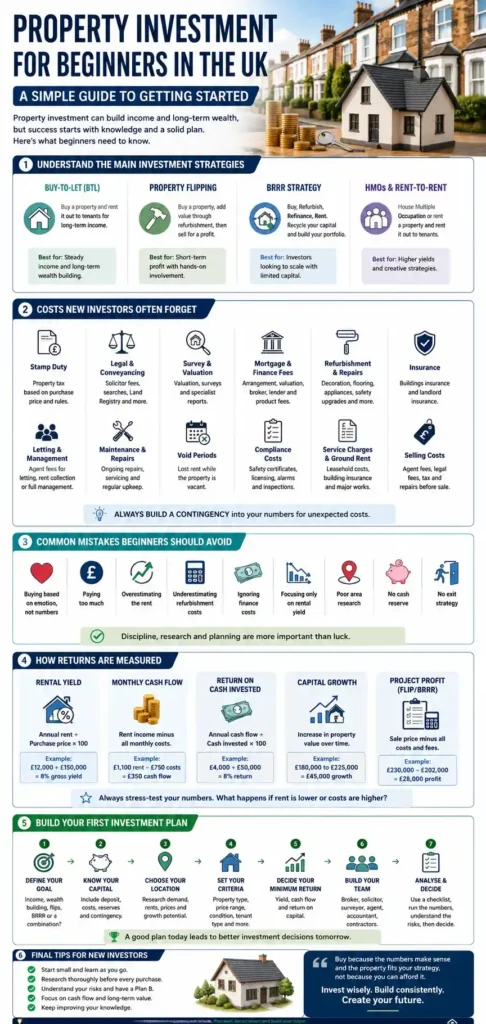
What Returns Should a Beginner Property Investor Expect?
One of the first questions new property investors ask is:
“How much money can I make?”
Unfortunately, there is no single percentage or monthly figure that represents a good return for every UK property investment.
Returns vary according to the location, property type, investment strategy, amount of borrowing, purchase price, running costs and level of risk involved.
A conventional buy-to-let will also produce returns differently from a property flip or BRRR project.
Rather than searching for one ideal percentage, beginners should understand the different ways property returns can be measured.
Rental Yield
Rental yield is one of the most commonly used measures for buy-to-let property.
Gross rental yield is calculated as:
Annual Rent ÷ Purchase Price × 100
For example, if you purchase a property for £150,000 and receive £1,000 per month in rent:
Annual rent = £12,000
£12,000 ÷ £150,000 × 100 = 8%
The gross rental yield is therefore 8%.
This is useful for quickly comparing properties, but gross yield ignores most of the costs of owning the investment.
That is why it should not be used on its own.
Net Rental Yield
Net yield attempts to provide a more realistic picture by considering relevant operating expenses.
Suppose the same property produces £12,000 in annual rent but has £2,500 of annual operating costs included in your calculation.
The remaining income would be:
£12,000 − £2,500 = £9,500
A simplified net yield calculation would then be:
£9,500 ÷ £150,000 × 100 = approximately 6.3%
The exact calculation you use should be consistent when comparing properties, particularly regarding which expenses are included.
Monthly Cash Flow
For many buy-to-let investors, the most important figure is simply how much money is left each month.
Suppose a property produces:
Monthly rent: £1,100
And the costs included in your calculation are:
Mortgage: £500
Management: £110
Maintenance allowance: £80
Insurance and other costs: £60
That leaves:
£1,100 − £750 = £350
The estimated monthly cash flow is therefore £350.
But remember that real-world cash flow will vary. A large repair or a period without a tenant can reduce the annual result considerably.
Return on the Cash You Invest
If you use a mortgage, measuring the return against the full property price does not tell you the whole story.
You may also want to understand what return you are generating on your own capital.
Suppose your total cash invested — including deposit and acquisition costs — is £50,000.
If the property generates £4,000 per year after the expenses included in your calculation:
£4,000 ÷ £50,000 × 100 = 8%
Your annual cash return on the capital invested would be approximately 8% based on those assumptions.
This can be particularly useful when comparing different ways of deploying your available money.
Capital Growth
Rental income is only one potential source of return.
If a property’s value increases over time, you may also benefit from capital growth.
For example:
Purchase price: £180,000
Value several years later: £225,000
Increase in value: £45,000
However, the £45,000 should not automatically be treated as £45,000 of realised profit.
There may be selling costs, financing considerations, improvements made to the property and tax implications.
More importantly, future capital growth cannot be known with certainty when you purchase.
It is therefore generally sensible to treat future appreciation as a potential benefit rather than the only reason an investment works.
Returns From Property Flipping
Returns from a flip are measured differently because the objective is normally to create and realise a profit through resale rather than collect long-term rent.
A simplified calculation might look like:
Sale price: £230,000
Purchase price: £150,000
Refurbishment: £30,000
Other acquisition, finance and selling costs: £22,000
Estimated profit:
£230,000 − £150,000 − £30,000 − £22,000 = £28,000
The £80,000 difference between purchase and resale price therefore does not mean the investor made an £80,000 profit.
The complete cost of the project matters.
Returns From BRRR
BRRR introduces another important measure: how much of your original capital remains in the property after refinancing.
An investor might successfully increase the property’s value but still leave more money invested than expected if:
- refurbishment costs increase;
- the final valuation is lower;
- the lender offers a lower loan-to-value;
- finance costs are higher; or
- refinancing criteria change.
This is why BRRR should not be judged solely by the increase in property value.
The rental performance after refinancing also needs to make sense.
What Is a “Good” Property Return?
There is no universal answer.
A return that is attractive to one investor may be unacceptable to another.
For example, an investor might accept a lower rental yield in an area they believe offers strong long-term fundamentals and lower management requirements.
Another investor may prioritise higher monthly cash flow and therefore target higher-yielding locations.
The appropriate return also needs to reflect the risk involved.
An investment requiring major refurbishment, expensive short-term finance and a difficult exit should generally need a stronger potential reward than a straightforward rental property requiring little work.
Compare Return With Risk and Effort
Instead of asking only:
“What percentage return does this property make?”
also ask:
How much money am I risking?
How much work will this require?
How dependent is the return on optimistic assumptions?
How easily can I exit?
What happens if the property underperforms?
A projected 15% return is not automatically better than an 8% return if achieving the 15% requires significantly more risk, time and uncertainty.
Set Your Own Minimum Investment Criteria
As you gain experience, you can establish minimum return criteria appropriate to your strategy.
For example, you might decide that a buy-to-let needs to produce a certain minimum cash flow and rental yield before you will consider it.
For a refurbishment project, you might require a larger margin to compensate for construction and resale risk.
The precise targets are personal.
What matters is establishing them before you become emotionally committed to a property.
Your investment criteria give you a benchmark against which potential opportunities can be measured.
And that leads naturally to the next step: putting everything we have covered so far into a simple property investment plan for your first purchase.
Building Your First Property Investment Plan
By this stage, you understand the basic investment strategies, costs, financing options and ways of measuring potential returns.
The next step is turning that knowledge into a practical plan.
Without a plan, it is easy to spend months browsing property portals, attending viewings and looking at completely different types of opportunities without getting any closer to making a sensible investment.
Your first property investment plan does not need to be complicated. It should simply establish what you want to achieve, what you can afford and what type of property you are prepared to buy.
Define Your Investment Goal
Start by deciding what you want property investment to achieve.
Your goal might be:
- additional monthly income;
- long-term wealth creation;
- building a rental portfolio;
- completing profitable refurbishment projects; or
- creating a combination of income and capital growth.
Try to make the objective more specific.
Instead of:
“I want to make money from property.”
you might decide:
“I want to buy my first long-term rental property that produces positive monthly cash flow and can be held for at least ten years.”
That immediately gives you a clearer direction.
Establish Your Available Capital
Work out how much money you can realistically invest without leaving yourself financially exposed.
Include money required for:
- the deposit;
- property transaction tax;
- legal costs;
- surveys;
- finance fees;
- refurbishment;
- initial compliance or preparation; and
- contingency.
Then decide how much you want to retain as an emergency reserve.
If you have £60,000 available but want to retain £10,000 for emergencies, your investment budget is effectively closer to £50,000.
Choose One Primary Strategy
Beginners can easily become distracted by trying to pursue multiple strategies simultaneously.
One week you are looking for buy-to-let properties.
The next week you are searching for flips.
Then you discover HMOs and begin looking for six-bedroom houses.
A more focused approach is to choose one primary strategy and learn what makes a good property for that strategy.
You can expand into other strategies as your knowledge and experience grow.
Create a Location Shortlist
Rather than searching across the whole of the UK, select a manageable number of target locations.
For each area, investigate:
- typical purchase prices;
- achievable rents;
- rental demand;
- employment;
- transport;
- property types;
- resale demand; and
- neighbourhood differences.
You may eventually decide that one or two locations fit your strategy significantly better than the others.
The more focused your search becomes, the easier it is to recognise when a property represents good value.
Define Your Property Criteria
Now decide what type of property you want to buy.
For example:
Strategy: Buy-to-let
Maximum purchase price: £160,000
Property type: Two or three-bedroom house
Condition: Mortgageable, light refurbishment acceptable
Target tenant: Working household or family
Location: Selected postcodes within two target areas
Objective: Positive cash flow and long-term hold
Your criteria could also include whether you will consider leasehold property, auctions, vacant properties or projects requiring refurbishment.
The purpose is to reduce the number of unsuitable properties you spend time investigating.
Decide Your Minimum Acceptable Return
Before you start making offers, decide what level of return would make an investment worthwhile for you.
Depending on the strategy, you might establish criteria for:
- minimum gross yield;
- minimum monthly cash flow;
- minimum return on invested capital; or
- minimum profit margin on a refurbishment project.
There is no universal figure that every investor should use.
Your target should reflect your objectives, available alternatives and the level of risk involved.
Most importantly, establish your target before finding a property you desperately want to buy.
Otherwise, there is a temptation to change your criteria to make the deal fit.
Build Your Property Team
Property investment involves several specialist areas, and you do not need to handle all of them yourself.
Depending on your strategy, your professional network may include:
- mortgage broker;
- solicitor or conveyancer;
- accountant or tax adviser;
- surveyor;
- estate agent;
- letting agent; and
- reliable contractors or tradespeople.
If you are investing outside your local area, having dependable people on the ground becomes even more valuable.
You do not necessarily need every professional in place before you start searching, but identifying reliable contacts early can make the buying process much smoother.
Create a Simple Deal Checklist
Before progressing with any potential purchase, ask the same core questions.
For example:
- Does it fit my strategy?
- Is it within my budget?
- Is there evidence supporting the value?
- Is the expected rent realistic?
- What are the total purchasing costs?
- Does it require refurbishment?
- What are the likely ongoing expenses?
- What return could it generate?
- What are the main risks?
- What is my exit strategy?
If you cannot answer an important question, that usually means you need more information before committing.
Set Your Maximum Budget and Stick to It
Your budget should not increase simply because you find a property you like.
This becomes particularly important when negotiating or bidding at auction.
Decide beforehand how much you can afford to pay while still achieving your required return.
If the property goes beyond that figure, walk away.
There will be other opportunities.
Review and Improve Your Plan
Your first investment plan does not have to remain unchanged forever.
As you analyse properties, you may discover that your original criteria were unrealistic.
Perhaps your target area does not produce the rental yield you expected.
Maybe properties within your budget require more refurbishment than you are comfortable managing.
Adjusting your plan based on evidence is sensible.
Changing it every week because you have discovered another exciting property strategy is not.
The objective is to create enough structure to make consistent investment decisions while remaining flexible when the evidence tells you something needs to change.
With a basic plan in place, it becomes much easier to evaluate opportunities objectively.
Next, let’s put the numbers together with a simple example of how a first UK property investment might work in practice.
Property Investment for Beginners: A Simple Example
We have covered purchase costs, mortgages, rental yield, cash flow and return on investment separately. Now let’s bring those figures together using a simple example.
Imagine you are considering a two-bedroom house as your first buy-to-let investment.
The figures below are illustrative and have been simplified to demonstrate how the calculations work.
The Property
Suppose the property is available for:
Purchase price: £160,000
After researching comparable rental properties and speaking with local agents, you estimate that it could realistically achieve:
Monthly rent: £1,100
That gives annual gross rental income of:
£1,100 × 12 = £13,200
Before deciding whether that represents a good investment, we need to consider the purchase and financing costs.
Deposit and Mortgage
Assume, for illustration, that you obtain a 75% loan-to-value buy-to-let mortgage.
The mortgage would be:
£160,000 × 75% = £120,000
Your deposit would therefore be:
£160,000 − £120,000 = £40,000
But the £40,000 deposit is not the total amount of cash required.
Suppose your other initial costs are approximately:
| Cost | Illustrative Amount |
|---|---|
| Deposit | £40,000 |
| Property transaction tax | £9,000 |
| Legal and searches | £1,800 |
| Mortgage/valuation fees | £1,500 |
| Survey | £600 |
| Initial improvements | £4,000 |
| Total initial cash required | £56,900 |
These are example figures rather than a tax or finance quotation. Actual costs will depend on your circumstances and the transaction.
You may also want to retain a separate emergency reserve rather than investing every pound available.
Calculate the Gross Rental Yield
The property’s annual rent is £13,200.
Using the purchase price of £160,000:
£13,200 ÷ £160,000 × 100 = 8.25%
The property’s gross rental yield is therefore approximately 8.25%.
At first glance, that may look attractive.
But gross yield does not account for the cost of operating or financing the property.
Estimate the Monthly Cash Flow
Now suppose your estimated monthly costs are:
| Item | Monthly Amount |
|---|---|
| Rental income | £1,100 |
| Mortgage interest | £475 |
| Property management | £110 |
| Maintenance allowance | £80 |
| Insurance | £30 |
| Other ongoing allowance | £45 |
| Estimated monthly cash flow | £360 |
Based on these assumptions, the property produces approximately:
£360 per month
or:
£360 × 12 = £4,320 per year
This provides a much more useful picture than simply looking at the £1,100 monthly rent.
Allow for Void Periods
Now let’s make the calculation slightly less optimistic.
Suppose the property is empty for one month during the year.
Instead of receiving £13,200 in annual rent, you receive:
£1,100 × 11 = £12,100
Some expenses continue even when the property is vacant.
Your annual cash flow would therefore be lower than the £4,320 calculated under the assumption of twelve fully occupied months.
This demonstrates why investors should avoid assuming perfect occupancy every year.
What Is the Return on Your Cash?
Using our original simplified example, annual cash flow is £4,320 and the initial cash invested is approximately £56,900.
A basic cash return calculation would therefore be:
£4,320 ÷ £56,900 × 100 = approximately 7.6%
Based on the expenses included in our example, the investment produces an estimated annual cash return of around 7.6% before tax.
Again, this is not a prediction of what a real investment will achieve. It simply demonstrates how the different numbers interact.
Now Stress-Test the Investment
Suppose circumstances change.
Instead of achieving £1,100 per month, you achieve only £1,000.
At the same time, your mortgage cost increases by £75 per month.
Your cash flow could fall by approximately:
£100 lower rent + £75 additional finance cost = £175 per month
The original £360 monthly cash flow could therefore fall to around:
£185 per month
The property might still produce positive cash flow, but the return is now considerably lower.
This is why stress-testing matters.
You want to understand what happens when reality is less favourable than your original assumptions.
What About Capital Growth?
Suppose the property increases in value from £160,000 to £200,000 over a number of years.
That would represent:
£40,000 of potential capital growth
However, you should not build your original investment case around the assumption that this will happen.
Property values can rise or fall, and different areas perform differently.
If capital growth occurs, it can strengthen the overall investment return.
But a beginner should be cautious about buying a poor cash-flowing property purely because they expect substantial future appreciation.
What Does This Example Tell Us?
There is no single number that tells you whether a property is a good investment.
In this example, we considered:
- purchase price;
- deposit;
- acquisition costs;
- rental income;
- gross yield;
- mortgage cost;
- operating expenses;
- monthly cash flow;
- cash invested;
- return on cash; and
- what happens if some assumptions change.
That is the mindset to develop.
Do not ask only:
“How much is the rent?”
Instead ask:
“After buying, financing and operating this property, what return could my money realistically generate — and what happens if things do not go exactly as planned?”
If you can answer that question before committing to a purchase, you are already approaching property investment more systematically.
There are, however, several questions that come up repeatedly when people are considering their first investment property. Let’s answer some of the most common ones next.
Frequently Asked Questions About Property Investment for Beginners
Can I Invest in Property With £20,000?
Potentially, but your options may be limited.
Whether £20,000 is enough depends on property prices, the deposit required, your financing, purchasing costs and the strategy you intend to use.
Remember that you need to consider more than the deposit. Legal fees, property transaction tax, mortgage costs, surveys, refurbishment and an emergency reserve can all increase the amount of capital required.
Rather than asking whether a particular amount is enough to “get into property”, calculate the total cash requirement for the specific investment you are considering.
Can I Invest in Property Without Owning My Own Home?
Potentially, yes. You do not necessarily have to own your own home before purchasing an investment property.
However, mortgage availability and lender criteria can differ for first-time buyers or first-time landlords. Your income, deposit, credit profile, property type and expected rent may all affect your options.
Speaking to an appropriate mortgage broker before searching seriously can help you understand what finance may be available.
What Is the Best Property Investment Strategy for Beginners?
There is no single best strategy.
For some beginners, a straightforward buy-to-let may be easier to understand and manage than an HMO, major refurbishment or development project.
For others with relevant experience, sufficient capital and a reliable team, a refurbishment or BRRR project may be appropriate.
The best strategy is generally one that matches your capital, knowledge, available time, objectives and tolerance for risk.
Avoid choosing a strategy simply because someone else appears to be making large profits from it.
Is Buy-to-Let Still Worth It in the UK?
Buy-to-let can still work when the property is purchased at an appropriate price, rental demand is strong and the income provides an acceptable return after costs.
However, higher financing costs, taxation, regulation, maintenance and other expenses mean investors need to analyse potential purchases carefully.
The more useful question is not:
“Is buy-to-let still worth it?”
but:
“Does this particular buy-to-let produce an acceptable return for the money and risk involved?”
What Is a Good Rental Yield in the UK?
There is no rental yield that automatically makes a property a good investment.
A higher yield may provide stronger income, but it can sometimes come with weaker locations, greater management requirements or other risks.
Likewise, some lower-yielding properties may be in areas with strong demand and different long-term characteristics.
Use rental yield as one measure alongside cash flow, costs, tenant demand, property condition, financing and your investment objectives.
How Many Properties Do I Need to Make a Living?
There is no fixed number.
Five strongly cash-flowing properties could potentially generate more usable income than ten properties with high mortgage costs and weak cash flow.
Instead of focusing on the number of properties, work backwards from the income you want.
For example, if your long-term target were £3,000 per month in pre-tax property cash flow and your properties averaged £300 per month, you would need roughly ten properties producing that level of performance.
That is only a simplified illustration. Actual cash flow will fluctuate, and tax, vacancies, repairs and financing need to be considered.
Focus on the quality and performance of the portfolio, not simply the number of properties owned.
Should I Buy Property Personally or Through a Limited Company?
It depends on your circumstances.
Personal and limited-company ownership can have different implications for taxation, mortgage products, administration and how profits are extracted and used.
If you intend to build a portfolio, it can be particularly useful to consider the ownership structure before purchasing your first property because transferring properties later can have tax and transaction-cost implications.
Obtain appropriate tax and mortgage advice rather than choosing a structure solely because another investor uses it.
Do I Need a Property Mentor or Training Course?
No course or mentor is a requirement for becoming a property investor.
There are useful education and training providers, but beginners should be cautious about expensive programmes promising rapid financial freedom or suggesting that property investment is easy and virtually risk-free.
There is a great deal you can learn through reputable resources, professional advisers, local market research and analysing real properties.
If you do pay for training, understand exactly what you are buying and avoid allowing the cost of a course to pressure you into purchasing a property before you are ready.
Can You Invest in Property With No Money?
Claims about investing in property with “no money” should be treated cautiously.
Some strategies involve using other people’s capital, joint ventures or various forms of borrowing, but that does not mean the investment requires no money.
Someone is still providing the capital, and borrowing or investor funding creates financial and potentially legal obligations.
For a beginner, it is more useful to understand where the capital comes from, what it costs and what happens if the investment underperforms.
Can Property Investment Lose Money?
Yes.
Property investment is not guaranteed to make money.
You could lose money because:
- property prices fall;
- you overpay;
- refurbishment costs exceed budget;
- rental income is lower than expected;
- finance becomes more expensive;
- the property remains vacant;
- major repairs arise; or
- you have to sell at an unfavourable time.
This is why due diligence, sensible borrowing, adequate reserves and realistic calculations matter.
Should I Buy the Cheapest Property I Can Find?
Not necessarily.
A low purchase price does not automatically mean good value.
Cheap properties may sometimes offer attractive returns, but investigate why they are cheap.
There may be weak rental demand, poor resale prospects, substantial repairs, financing difficulties or other issues.
The objective is not to find the cheapest property.
It is to find a property available at a price that makes sense for your investment strategy.
How Long Should I Hold an Investment Property?
That depends on your strategy.
A buy-to-let investor may intend to hold a property for many years, while a property flipper may plan to sell within months.
Your intended holding period should be considered before buying because transaction costs can make repeatedly buying and selling property expensive.
For long-term investments, periodically review whether the property is still meeting your objectives rather than assuming you must hold it forever.
What Should I Do Before Buying My First Investment Property?
Before committing to your first purchase, you should ideally be able to answer five basic questions:
- What is my strategy?
- How much money will I need in total?
- Why is this particular location suitable?
- What return could the property realistically produce?
- What is my exit strategy if things do not go as planned?
If you cannot answer one of these questions, you may need to do more research before committing your money.
Property investing does not require you to predict the future perfectly. It requires you to make decisions using realistic information, understand the risks you are taking and avoid relying on everything going according to the best-case scenario.
With those fundamentals in place, we can bring everything together with some final thoughts on how to get started with UK property investment.
Final Thoughts: Getting Started with UK Property Investment
Getting started in property investment does not mean you need to know everything before buying your first property.
But you should understand enough to make an informed decision.
The fundamentals are relatively straightforward: know what you want to achieve, understand how much capital you have available, choose an appropriate strategy, research your target market and make sure the numbers work before committing your money.
The difficult part is often having the discipline to follow those principles when you find a property you really want to buy.
Start With a Clear Plan
Before searching seriously for your first investment, write down:
- your investment objective;
- your available capital;
- your preferred strategy;
- your target locations;
- the type of property you want;
- your minimum acceptable return; and
- your intended exit strategy.
This does not need to be a complicated business plan.
Even a one-page investment plan can give you something against which to measure potential opportunities.
Instead of looking at every property that appears interesting, you can concentrate on those that genuinely fit what you are trying to achieve.
Learn by Analysing Real Properties
You do not have to buy immediately to start gaining useful experience.
One of the best ways to learn is to analyse properties currently on the market.
Choose a property and estimate:
What is it realistically worth?
What rent could it achieve?
What would the total purchase cost be?
Does it require refurbishment?
What would the mortgage and running costs be?
What cash flow could it produce?
What return would I make on my invested capital?
Then repeat the exercise with another property.
After analysing enough opportunities in the same area, you will begin to recognise typical prices, rents and property conditions much more quickly.
Build Your Team Before You Need It
You do not need to become an expert in mortgages, taxation, construction, surveying and property law.
You do need to know when professional advice is appropriate.
Depending on your strategy, start building relationships with people such as a:
- mortgage broker;
- solicitor or conveyancer;
- accountant or tax adviser;
- surveyor;
- letting agent; and
- reliable contractor.
Having the right people available can make it much easier to investigate and progress an opportunity when you find one.
Don’t Rush Your First Purchase
There is no prize for becoming a property investor as quickly as possible.
If the first property you analyse does not work, look at another.
If the numbers only work when you assume the highest possible rent, the lowest refurbishment cost and strong future capital growth, reconsider the investment.
And if your due diligence identifies a problem that materially changes the deal, be prepared to walk away.
Missing one property is usually far less expensive than buying the wrong one.
Your First Investment Doesn’t Need to Be Perfect
At the same time, avoid becoming so focused on finding the perfect property that you never make a decision.
No investment is completely risk-free.
Property prices can change. Repairs can arise. Tenants can leave. Interest rates can move. Refurbishments can encounter unexpected problems.
The objective is not to eliminate every possible risk.
It is to understand the major risks, price them into your decision where possible and make sure you have enough financial margin to deal with reasonable setbacks.
Focus on Buying Well
Your first property can form the foundation for everything that follows.
A successful first investment can give you practical experience of buying, financing, managing and eventually refinancing or selling property.
But building a portfolio should never become a race to accumulate as many properties as possible.
One well-researched property that produces sustainable returns can be more valuable than several poorly performing properties purchased simply to increase your portfolio size.
So before making your first offer, remember the central principle running throughout this guide:
Don’t buy a property simply because you can afford it. Buy because you understand how the investment works, the numbers make sense and the property fits your strategy.
That is a much stronger starting point for building a successful UK property investment journey.
Pingback: Property Deal Sourcing Explained for Beginners - Property Investing Made Simple